Where Kindred Spirits Gathered: Julie’s Early Denver Folklore Center Days
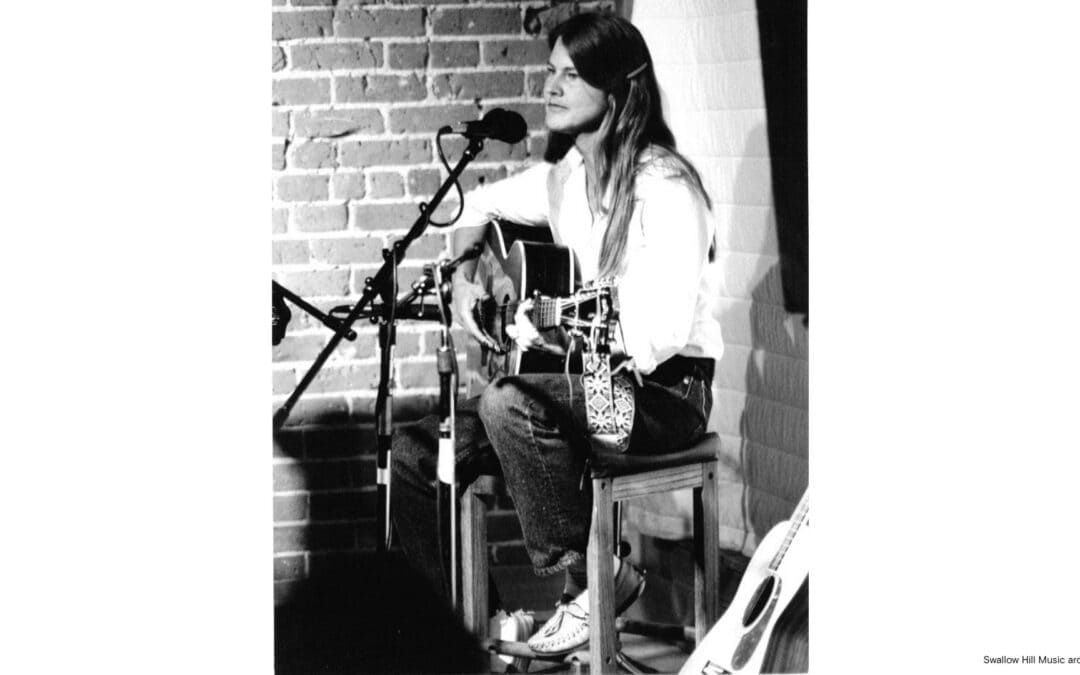
Julie Davis is a fifth-generation Coloradan and was attending Denver’s East High School when she was hired at the Denver Folklore Center (DFC) in 1962. Self-taught on the guitar, she’d already memorized dozens of folk songs by famous artists like Joan Baez and Judy Collins by the time she was 14.
“From the beginning, the DFC was a gathering of kindred spirits… We were there every Sunday. You just didn’t miss one… I was one of the younger people at the Folklore Center. I had wanted to take lessons with Harry, but he thought I knew too much since I had taught myself a great deal… So the very first job I ever had, even before I had a driver’s license, was teaching guitar at the Folklore Center.”
Stepping Up in a Crisis: Returning with Vision
Fast forward to the early 1980s. Swallow Hill was in a precarious position and desperately needed a spark of new energy. The DFC had closed, and Swallow Hill, then known as Music Association of Swallow Hill (M.A.S.H.), was struggling to survive in a small space, at the Capitol Hill Community Center.
In 1984, Julie stepped forward, agreeing to take over the school operations, working completely on commission. She recalled, “It felt like it (Swallow Hill) needed someone who believed it could work.”
Her dedication and creativity quickly sparked a renewed energy and increased the demand for folk music classes. Julie expanded the school beyond just guitar lessons, adding classes for banjo, mandolin, bass, and harmonica.
Amplifying Growth: Putting Swallow Hill on the Map
By 1985, the school’s success reenergized Swallow Hill, allowing it to move out of the community center and into a new home at 1905 South Pearl Street.
“It was an intimate concert space, but so many people loved it, and the players really loved it. It was when Swallow Hill was put on the map because performers loved working there, so close to the audience. There was a community connected to it. It was, for the performers, different from just going into a place to play. It was more like visiting family. We were inundated with calls to book acts.”
Honoring Julie’s Legacy: The Namesake of the Music School
Julie resigned in 1987, knowing she had done what she could to rebuild the school and grow the institution. Throughout her time as director, she worked entirely on commission. Instead of taking a regular paycheck, she chose to advocate for fair salaries for the instructors, knowing she couldn’t fairly fight for pay raises if she was receiving one herself.
In December 2002, Swallow Hill officially named the music school after Julie Davis to honor her hard work and legacy. At the dedication, she perfectly described what a music school means to the world:
“To me a music school is a gift. In a fast-paced world too often filled with violence great and small, it is a sanctuary and a place to grow. There is something wonderful, even magical, that happens when people gather to share, learn, and pass on music. Distinctions blur, time dissolves and the music—that universal language of human emotions, hopes and dreams—fills the lesson room with immediacy, life, and feeling.”
The Folk Lore is an occasional feature by Swallow Hill Music’s Membership and Individual Donor Manager Sherise Talbott. It first appeared in our monthly Member email newsletter.
Become a Member today! Join our vibrant musical community to get the next level of access at Denver’s nonprofit home for concerts, classes, and community.